
How to Dress and Maintain Your Anvil Face

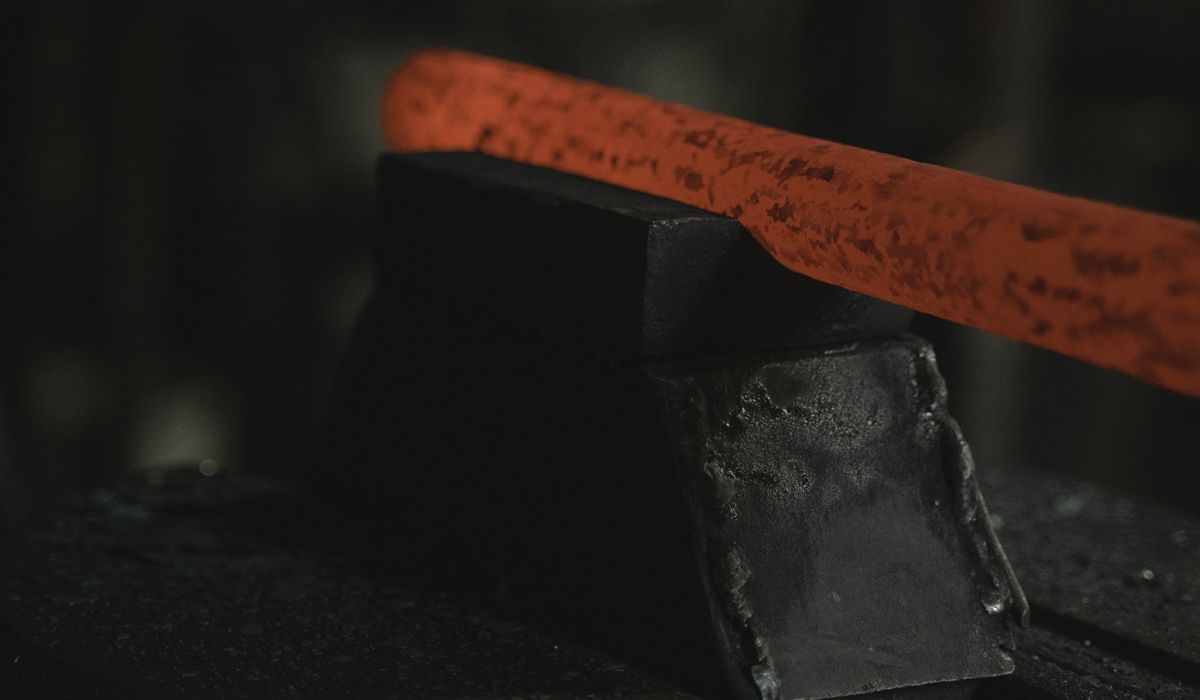
What a Working Anvil Face Should Actually Look Like
A new smith often assumes the ideal anvil face is mirror-smooth, almost like a surface plate. It isn't. What you want is a face that is flat enough to work on, smooth enough to finish against, and free from anything that will print itself into your hot metal. A face with a deep dent is a face that stamps a matching lump into every billet that crosses it.
Think of it as a spectrum. At one end is a battered car boot-sale anvil, picked up for forty quid, covered in chisel scars and with a swaybacked middle you could read a paper in. At the other is a face polished to a shine, which is worse in some ways: hot steel slides about on it, and the shine usually means somebody has been over-enthusiastic with a grinder. The sweet spot is a matte, slightly satin grey with crisp but rounded edges and no more than a whisper of a hollow in the centre.
Assess Before You Attack
Never start grinding until you know what you are dealing with. Ten minutes of inspection saves a face.
- Lay a straight edge across the face, lengthways and diagonally, and look for light underneath. A dip of a millimetre or so in the middle is normal and harmless. A dip of 3–4mm is annoying but workable; a bulge is far worse than a dip.
- Check the edge with a small square or a steel rule. Chipped, mushroomed or badly rounded edges tell you how the anvil was abused.
- Look for delamination — fine cracks or lifting along the line where a steel face plate meets a wrought iron body on older anvils. Grinding near that seam is how you lose the face entirely.
- Ring test lightly and check the rebound with a ball bearing. A dull thud with no bounce suggests a loose face, and that is a job for a specialist, not an angle grinder.
- Note where the hardy hole and pritchel hole are. The metal around them is often thin and should be left well alone.
Removing Dents Without Ruining the Face
The golden rule is to remove the minimum metal needed. Quality anvils are hardened to roughly 50–55 HRC, but that hardness only runs a few millimetres deep. Take too much off and you expose soft iron that dents the moment you miss a strike.
For shallow dings, start with a hand file or a coarse oilstone and work locally, checking with a straight edge as you go. For heavier damage, use an angle grinder fitted with a flap disc in 60 or 80 grit, moving constantly and never dwelling in one spot. Hard grinding discs are the wrong tool: they gouge and they build heat, and heat draws the temper out of the face.
Work in overlapping passes along the length of the anvil rather than in circles, then step up to 120 grit, and finish by hand with a stone or a worn flap disc to blend everything in. If the face gets warm enough that you would not want to hold your palm on it, stop and let it cool in the air. Never quench an anvil to speed things up.
When you have finished, wipe the face with an oily rag and check it again under a raking light. Any remaining dent that catches your fingernail will catch your workpiece.
Edges: Radius, Don't Razor
The edges are where most anvil damage begins, and they are also the most misunderstood part of dressing. A perfectly sharp 90-degree edge is brittle. It chips the first time you accidentally clip it with a hammer, and those chips then travel.
Instead, break the working edges with a gentle radius of roughly 3–6mm, blended smoothly into the face. This does two jobs: it makes the edge far more resistant to chipping, and it gives you a set of useful forming radii for drawing out, shouldering and bending.
Keep one edge, or a short section of one edge, a little crisper if you do a lot of shouldering work — but only a little. Never leave a burr. A raised lip of metal on the edge will flake off and end up somewhere unpleasant.
If you do chip an edge, dress it out as soon as you notice. Small chips grow, and a chip that reaches the face plate seam on an old anvil can write the whole tool off.
A Simple Maintenance Routine That Pays Off
An anvil's worst enemy is not heavy work; it is rust. Pitting from a damp shed will undo every bit of careful dressing in a single winter.
- Wipe the face with an oiled rag after every session, while it is still warm if possible.
- Keep the anvil indoors, or cover it with a breathable cloth over a wooden board. A plastic sheet traps condensation and makes things worse.
- Stand it on a solid wooden stump or a well-built stand, and keep the stand off damp concrete.
- Never use the face as a welding bench, a cutting block or an assembly table. Weld spatter and hacksaw scars are needless damage.
- Dress your hammers as carefully as your anvil. A chipped hammer face will transfer its faults into the anvil within a few weeks.
- Reserve heavy chisel cutting and sledge work for a separate striking block of mild steel, keeping your good anvil for forging.
How Much Metal Is Too Much
It is easy to keep chasing perfection and end up with a shiny, soft, useless anvil. Stop when the face is flat enough to work on, free of dents that would mark your work, and the edges are sound and consistently radiused. A little patina and a slight central hollow are signs of an anvil that has earned its keep, not faults to be ground away.
If the face is delaminating, if there is a crack running through it, or if a previous owner has already ground through the hardened layer, put the grinder down. Those are jobs for a specialist with the right equipment, and a good anvil is worth repairing properly rather than ruining cheaply.

Joeby Ragpa
This template is so awesome. I didn’t expect so many features inside. E-commerce pages are very useful, you can launch your online store in few seconds. I will rate 5 stars.
ReplyAlexander Samokhin
This template is so awesome. I didn’t expect so many features inside. E-commerce pages are very useful, you can launch your online store in few seconds. I will rate 5 stars.
ReplyChris Root
This template is so awesome. I didn’t expect so many features inside. E-commerce pages are very useful, you can launch your online store in few seconds. I will rate 5 stars.
Reply