
Understanding Carbon Steel for Beginner Blade Projects

Start With the Number, Not the Name
If you take one thing away from this article, let it be this: carbon content is the most useful number on any steel you pick up. It tells you whether the bar in your hand will harden at all, how fine an edge it will hold, and how forgiving it will be under the hammer. Names and labels are marketing; numbers are metallurgy.
In the AISI/SAE system used by most blade makers, the last two digits of a 10xx grade give the carbon content in points of a percent. So 1080 holds roughly 0.80 per cent carbon, and 1095 sits just under one per cent. European grades work differently — EN9 and EN45, for example, are British Standard specifications where the number is a reference, not a carbon figure — so always read a data sheet rather than guessing from the name. A quick spark test at the grinder will confirm the ballpark, but it will not replace a known grade.
A Rough Map of Carbon Ranges
- Under 0.30 per cent (low carbon): mild steel and similar. It will not harden meaningfully, no matter how you quench it. Superb for guards, bolsters, fittings, tongs, fire tools and decorative ironwork.
- 0.30 to 0.60 per cent (medium carbon): tough, hardenable, but not to knife-hardness. EN9, 1055 and the chrome-moly grades sit here. Ideal for hammers, axes, tomahawks and workshop tooling.
- 0.60 to 1.00 per cent (high carbon): the blade maker's home ground. 1075, 1080, 1084, EN45 and O1 all live here, and all will take a proper cutting edge.
- Above 1.00 per cent (very high carbon): 1095, W2 and bearing steels. Capable of superb edge retention, but less forgiving to forge and noticeably more prone to cracking in the quench.
Notice that "high carbon" is a narrow band. A tenth of a per cent either way changes how a steel moves, how it hardens, and how it behaves on the stones.
Grades That Suit a First Blade
For a beginner at a small gas forge or a solid-fuel hearth, the sweet spot is 1075, 1080 or EN45. All three are simple steels with no significant alloying, which means they harden easily, tolerate a range of quench speeds, and respond predictably to a kitchen oven temper. They are also widely available as flat bar in thicknesses of 3–5 mm and widths of 25–40 mm, which is exactly what a first knife wants.
If you want a steel that hardens in oil with very little fuss, O1 is a fine choice — it is an oil-hardening tool steel, dimensionally stable, and machines and files cleanly. Its trade-off is cost and slightly fussier heat treatment.
I would steer a new maker away from 1095 and from mystery steel for a first project. Car springs, old files and mystery bar stock can make lovely knives, but if you do not know the carbon content, your heat treatment is guesswork, and guesswork is where beginners lose blades. A known grade with a known carbon figure lets you follow a recipe and actually see it work.
How Carbon Changes Your Time at the Forge
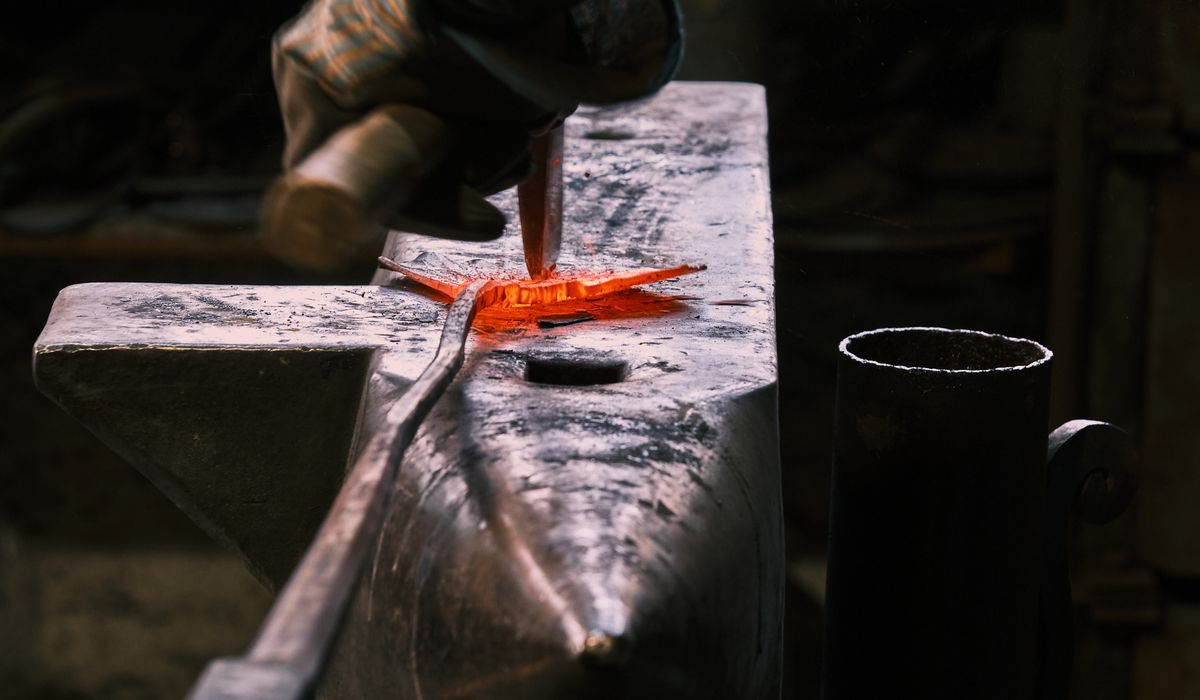
Carbon does not just decide the edge; it decides the whole rhythm of your session. Low carbon steel will happily move at a bright yellow heat and keeps working down to a dull red. High carbon steel has a narrower window. Push 1080 too hot and you risk burning it — that fizzy, sparkler-like surface — while working it too cool invites cracking at the edges.
As a rule, forge high carbon steel at a bright orange, around 1,100 to 1,200 °C, and stop shaping once it drops below a cherry red. If it starts to feel stiff under the hammer, back into the fire it goes. Higher-carbon steels also work-harden faster, so take lighter blows and more heats rather than trying to force a shape in one pass. And whatever the grade, normalise the finished blade two or three times before hardening — it costs you ten minutes and rescues grain structure you have thumped into a mess.
Heat Treating: Match the Method to the Steel
The quench is where carbon earns its keep. On cooling fast enough, carbon traps itself in the crystal structure and the steel transforms into martensite — hard, and if you are not careful, brittle.
- 1075, 1080, 1084: warm oil is the safe default. Water will harden 1075 quickly but risks warping thin sections.
- EN45 and 5160-type spring steels: oil quench from around 830–860 °C.
- O1: oil quench from roughly 800–820 °C, then temper at 180–200 °C for a working knife edge.
- 1095 and very high carbon grades: fast oil, and expect to temper straight away to relieve stress.
Always test. Forge a small coupon from the same bar, harden it exactly as you plan to harden the blade, then snap it in a vice. Fine, silky grey grain means you are on track; coarse grain or a coupon that bends rather than snaps means something needs adjusting. Tempering at 200 °C gives a keen, harder edge; 230 °C trades a little sharpness for toughness. For a first camp knife, err towards toughness.
Buying and Storing Your Stock
Buy from a supplier who will tell you the grade and, ideally, supply a mill certificate. Ask for annealed, decarburised-free flat bar where possible — it saves hours of grinding. Store bar stock dry and lightly oiled, standing on end in a rack rather than leaning against a damp wall. Write the grade on the end of every bar with a paint pen the day it arrives. In six months, when you cannot remember whether that length is 1080 or mild steel, that five-second habit will save you a ruined blade.

Joeby Ragpa
This template is so awesome. I didn’t expect so many features inside. E-commerce pages are very useful, you can launch your online store in few seconds. I will rate 5 stars.
ReplyAlexander Samokhin
This template is so awesome. I didn’t expect so many features inside. E-commerce pages are very useful, you can launch your online store in few seconds. I will rate 5 stars.
ReplyChris Root
This template is so awesome. I didn’t expect so many features inside. E-commerce pages are very useful, you can launch your online store in few seconds. I will rate 5 stars.
Reply