
Choosing Protective Clothing for Hot Metal Work

Why What You Wear Matters More Than You Think
Spend an afternoon at the anvil and you will quickly learn that hot metal does not stay where you left it. Scale flicks off the stock the moment it hits the anvil, sparks arc out from the grinder, and the radiant heat from an open forge will warm your forearms long before you feel any discomfort elsewhere. None of that is unusual, and none of it needs to be frightening — but it does mean that your clothing is part of your toolkit, not an afterthought.
The good news is that protecting yourself properly is neither expensive nor complicated. You do not need laboratory-grade equipment to work safely in a small workshop. You need the right materials, sensible coverage, and a clear understanding of how heat behaves around the human body. Get those three things right and you can concentrate on the metal rather than on the burn.
Natural Fibres, Always
This is the single most important rule in hot metal work, and it is worth stating plainly: wear natural fibres next to and over your skin, and keep synthetics well away from the forge.
Cotton, wool and leather behave predictably around heat. They may scorch, char, or even smoulder, but they generally do not melt. Synthetic fabrics do the opposite. Polyester, nylon, acrylic, elastane and the soft fleece of an old sports top will soften, melt and fuse to skin when they meet a spark or a fleck of hot scale. What would have been a small red mark becomes a much nastier injury, and one that is difficult to treat because the fabric is welded to the wound.
Have a look at the labels before you next light the forge:
- Avoid polyester and cotton-poly workwear, sports tops, leggings, fleece, and anything with a fleece lining. Even a small percentage of synthetic fibre is a risk.
- Choose heavy cotton drill, cotton canvas, woollen shirts in winter, and leather for any surface likely to take direct hits.
- Check the stitching and any elastic panels, cuffs or knee pads — these are often the hidden synthetics.
- Retire thin, worn or frayed garments. A frayed cotton hem is a fine place for scale to lodge and smoulder.
Aprons, Trousers and Boots
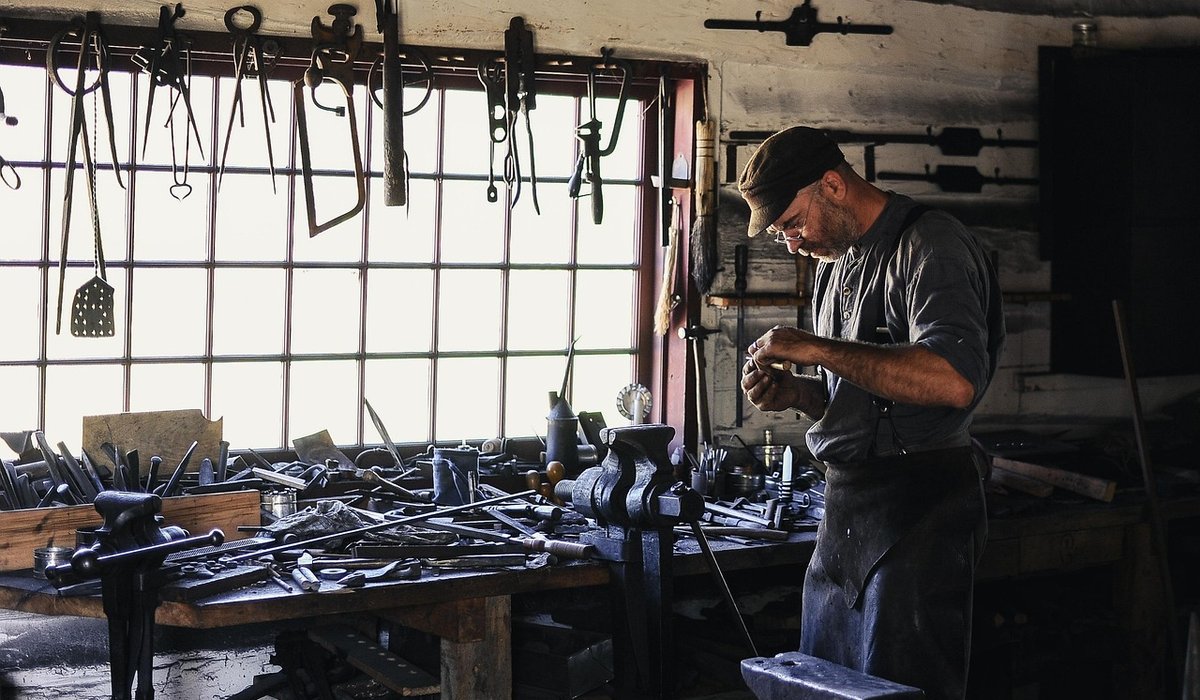
A split-leather apron is the piece of kit most smiths buy first, and with good reason. Look for one in the region of 1.2mm to 1.5mm thick, long enough to cover from the chest to below the knee if you do a lot of forge work, or a shorter waist apron if you mostly grind and finish. Leather straps with metal buckles last far better than plastic fittings, which become brittle near heat. Treated properly — wiped clean, kept dry, hung rather than folded — a decent apron will serve you for years.
Underneath it, wear long trousers in heavy cotton or wool. Avoid turn-ups and cuffs, which are perfect pockets for hot scale, and keep hems unfrayed. Tuck your trousers over your boot tops rather than into them, so that anything falling from above slides off rather than down into your footwear.
Boots should be leather, ideally with a defined heel and no mesh panels. Laces are a weak point; if your boots have them, choose leather laces or at least keep them short and knotted tightly away from the tongue opening. Trainers, with their foam soles and synthetic uppers, are best left by the door.
Gloves: When to Wear Them and When to Take Them Off
Gloves are more nuanced than most beginners expect. A leather gauntlet glove on your tong hand is almost always a good idea — it lets you hold stock close to the forge without flinching. For the hammer hand, many smiths prefer bare skin, or a thin leather glove at most, because feel and control matter more than padding.
Never wear gloves near rotating machinery. A power hammer, pillar drill, linisher or lathe will pull a loose glove in faster than you can react.
- Split leather gauntlets for handling hot stock and tongs
- Thinner, close-fitting leather for hammer work if you want protection with feel
- Heat-resistant aramid gloves for brief contact with very hot pieces, not for prolonged holding
- No gloves at all around anything that spins, turns or reciprocates
Eyes, Face and Ears
Eye protection is not optional. Wear close-fitting safety glasses to the relevant standard at all times in the workshop — scale is small, fast and hot, and it does not announce itself. Because hot fragments can travel past the top of a lens, choose a style with a snug upper edge and avoid looking down into the forge without eye cover.
Add a face shield over your glasses for grinding, cutting and wire brushing, and reach for tinted lenses if the glare of a gas forge or a bright welding job bothers you. Ear protection matters too: an hour of hammering on an anvil or a length of time at the linisher can do lasting damage, and the ringing afterwards is not a badge of honour.
Building a Sensible Setup Without Spending a Fortune
You can equip yourself gradually. Start with a leather apron, a pair of gauntlets, and a decent set of safety glasses. Add a face shield when you begin grinding in earnest, then a second pair of gloves for lighter work. Charity shops and surplus stores are excellent sources of heavy cotton shirts and woollen jumpers, provided you check the labels and reject anything with synthetic content.
Keep everything clean, dry and hung up, and inspect your gear before each session. If a glove has gone hard and cracked, or an apron strap is fraying at the buckle, replace it — the cost of a new pair of gloves is trivial next to a trip to the minor injuries unit. Dress for the work, respect the heat, and you will enjoy many comfortable years at the forge.

Joeby Ragpa
This template is so awesome. I didn’t expect so many features inside. E-commerce pages are very useful, you can launch your online store in few seconds. I will rate 5 stars.
ReplyAlexander Samokhin
This template is so awesome. I didn’t expect so many features inside. E-commerce pages are very useful, you can launch your online store in few seconds. I will rate 5 stars.
ReplyChris Root
This template is so awesome. I didn’t expect so many features inside. E-commerce pages are very useful, you can launch your online store in few seconds. I will rate 5 stars.
Reply